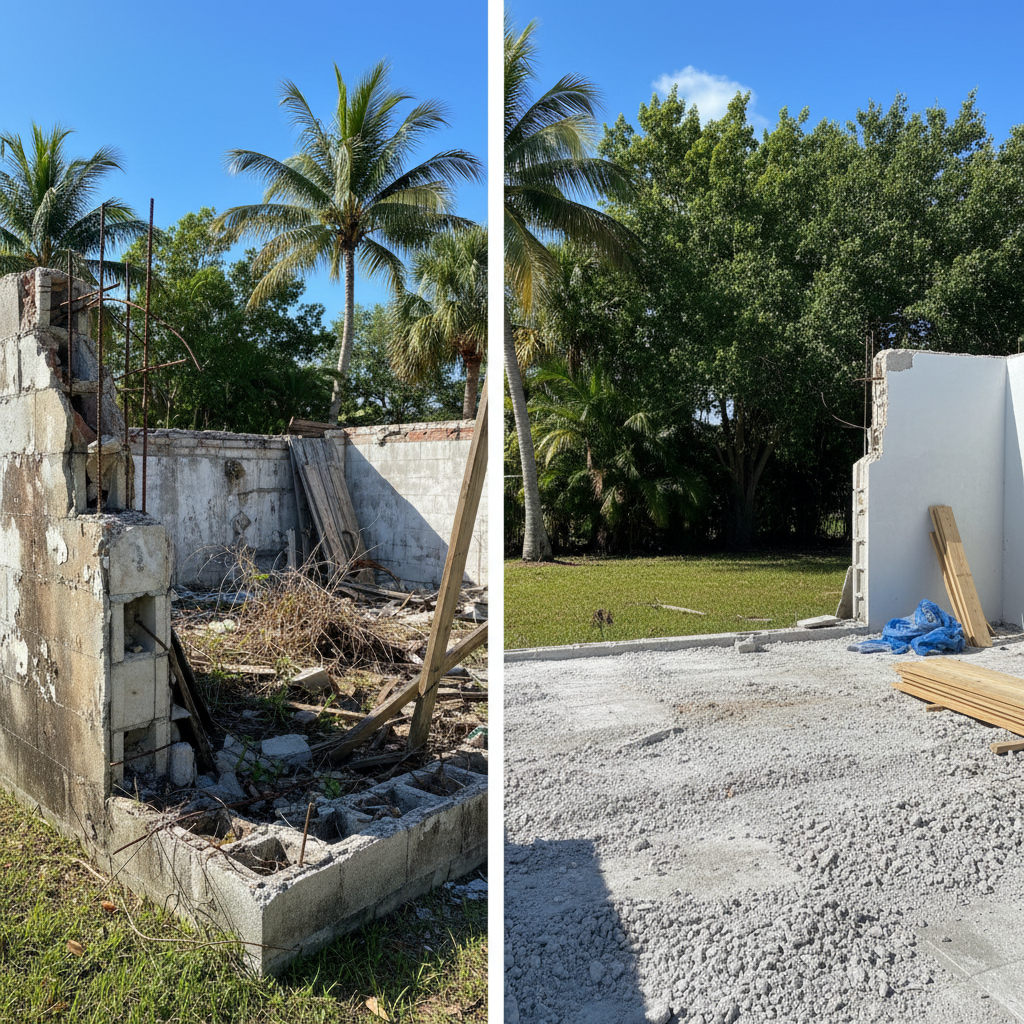
Alright, Cape Coral homeowners, let's talk about partial demolition. Maybe you're finally gutting that outdated kitchen, or perhaps you're taking out a non-load-bearing wall to open up your living space. It could even be that you're dealing with some hurricane damage that only affected a section of your home. Whatever the reason, you're not tearing down the whole house, just a part of it. But even a 'partial' job has a couple of ways you can go about it, and choosing the right one can honestly save you headaches, time, and money.
I've seen my fair share of projects here in Southwest Florida, from the canals of Yacht Club to the newer developments off Pine Island Road. The approach you pick for partial demolition really depends on what you're trying to achieve, the surrounding structure, and, of course, your budget. We're going to look at two main methods: what I call 'Surgical Selective Demolition' and 'Mechanical Removal.' Let's get into it, shall we?
Surgical Selective Demolition: Precision When It Counts
Think of this as the scalpel approach. Surgical selective demolition is all about precision, which means carefully dismantling specific parts of a structure piece by piece, while leaving the rest completely intact. This method uses smaller tools, hand tools, and sometimes specialized equipment like concrete saws, angle grinders, or even hydrodemolition (high-pressure water jets) to get the job done without disturbing surrounding areas. It's really about control.
Cost
Generally speaking, surgical selective demolition tends to be more labor-intensive, and that can drive up the initial cost. You're paying for skilled workers to meticulously remove materials, often by hand. However, because it minimizes collateral damage, you might actually save on repair costs for adjacent structures or finishes. It also allows for easier material salvage and recycling, which can sometimes help offset costs a bit.
Durability
The durability of the remaining structure is usually excellent with this method because the demolition is so controlled. There's less risk of unintended damage to load-bearing elements, foundations, or adjacent walls. If done right, the parts of your home you want to keep won't even know a demolition happened next door, which is pretty amazing.
Maintenance
Maintenance post-demolition is typically lower because the integrity of the preserved structure isn't compromised. You're not dealing with unexpected cracks or structural issues that can arise from less controlled methods. The focus shifts quickly to the new construction or renovation rather than fixing demolition-related problems, which is always a plus.
Appearance
This is where surgical selective demolition really shines. The clean cuts and minimal disruption mean that the transition between the demolished area and the preserved area is much smoother. If you're removing a wall, for example, the remaining walls will have clean edges, making it easier for your contractors to tie in new finishes smoothly. This is important for maintaining a high-quality aesthetic in your renovated space, especially in a place like Cape Coral where home values matter.
Mechanical Removal: Power and Efficiency
Now, let's talk about the sledgehammer and excavator approach. Mechanical removal uses heavier equipment like excavators with hydraulic attachments, jackhammers, or even skid steers to tear down sections of a building. It's faster and uses more brute force, but it's still targeted, not a full teardown. It's a different kind of power.
Cost
Mechanical removal can often be cheaper upfront because it's quicker and requires less specialized manual labor. You're paying for machine time and operator skill. However, there's a higher chance of needing more extensive repair work on areas adjacent to the demolition zone due to vibrations or accidental impacts. You might save on the demo itself, but spend more on patching things up afterward. Partial demolition costs can range from $5,000 to $25,000, depending on the scope of the job.
Durability
While effective, mechanical removal carries a slightly higher risk of impacting the durability of the remaining structure. The vibrations from heavy machinery can cause hairline cracks in nearby walls or foundations, especially in older homes or those built on our sandy Cape Coral soil. A good contractor will take precautions, but the risk is inherently higher than with surgical methods, and that's something to consider.
Maintenance
You might find yourself with more maintenance tasks down the road if the mechanical demolition wasn't executed perfectly. Things like small cracks appearing months later, or issues with plumbing and electrical lines that were jostled during the process. It's not a guarantee, but it's a possibility to think about when making your choice.
Appearance
The appearance can be a bit rougher initially. While a good crew will still aim for clean lines, the nature of heavy machinery means you might have more patching, drywall repair, or structural reinforcement needed to make the remaining sections look pristine. It's less about surgical precision and more about getting the bulk of the material out efficiently, which means more finishing work later.
So, Which One's Right for Your Cape Coral Home?
For most partial demolition projects in Cape Coral, especially those involving interior renovations or removing specific structural elements while preserving the main integrity of your home, I'm going to lean towards Surgical Selective Demolition. Here's why:
- Precision is Key: Our homes, especially those built to withstand hurricane seasons, have specific structural designs. You don't want to mess with that more than absolutely necessary. Surgical methods make sure only what needs to go, goes.
- Minimize Disruption: Cape Coral is a tight-knit community. Minimizing noise, dust, and vibration is always a good idea for your neighbors and your own sanity, honestly.
- Long-Term Value: While it might cost a bit more upfront, the reduced risk of damage and cleaner results often lead to lower overall project costs when you factor in repairs and finishing work. Plus, the final appearance will be superior, adding to your home's value, which is always a goal.
- Permitting: The City of Cape Coral's Development Services Department requires permits for most demolition work, even partial. A detailed plan for selective demolition often makes the permitting process smoother, as it clearly outlines what's being removed and what's staying.
Now, there are times when mechanical removal makes sense. If you're taking out a large, detached structure that's far from your main house, or if the section being removed is truly isolated and doesn't impact important structural elements, mechanical can be a faster, more economical choice. But for anything connected to your main living space, especially here where our homes are built on concrete slabs and often have block construction, you really want that surgical touch. Why take the chance?
At Paradise Demolition, we always assess your specific project to recommend the best approach. We'll walk you through the pros and cons for your unique situation, making sure you understand exactly what to expect. Don't just swing a hammer; plan it out right, that's what we say.